

The Morphological Economy Revisited
In this image from Dizzy Dishes (1930), one of Max Fleischer’s first Betty Boop cartoons, a chef tests the sharpness of a knife on a single hair, which proceeds to cut the knife in two like a piece of wire cuts through soft clay. Besides their function as sight gags, these images about the substance of beings and objects generate a sprawling network of narratives (including some antisemitic imagery) to examine in theoretical and historically-specific terms.
One of the visual hallmarks of the animated cartoon during this period is not just the contagious anthropomorphic movement of inanimate objects, but the unity of the movement, which is usually based in the direct relation to the rhythm of the recorded music. This is what gives much of the 1930s cartoon world its generally “pulsating” appearance as the elements move in unison.
A curious reordering of Marx’s conception of the commodity as dialectically composed of stillness and movement occurs in the cartoon world. Marx writes,
“That which in the laborer appeared as movement, now appears in the product as a fixed quality without motion. The blacksmith forges and the product is a forging”.11
11Marx, Karl. Capital. (a new abridgement). Edited by David McLellan. Oxford University Press, Oxford. 1995. p. 44.
The cartoon body object is an inversion of this relationship. The stillness of the object dissolves into movement by its performance of its function. This is autonomy-made-literal by anthropomorphic animation. The movement, rather than solidifying labor into a potential commodity, bewitches it as a quality of its identity and personality in the cartoon world.
Marx uses a bewitched anthropomorphic table as his figure of commodification magic, emphasizing exchange value, as a mystical quality which delivers a corporeal table-as-thing to an exalted status of commodity:
The form of wood, for instance, is altered, by making a table out of it. Yet, for all that, the table continues to be that common, every‑day thing, wood. But as soon as it steps forth as a commodity, it is changed into something transcendent. It not only stands with its feet on the ground, but, in relation to other commodities, it stands on its head, and evolves out of its wooden brain grotesque ideas, far more wonderful than table‑turning ever was.12
12Marx, Karl. Capital. (a new abridgement). Edited by David McLellan. Oxford University Press, Oxford. 1995. p. 44.
The “wooden brain” in Marx’s anthropomorphism feels steeped in corporeality and resonates with another from Dizzy Dishes, in which a snarling and ravenous customer at the cafe devours the table “leg” down to its “bone.”
“Thinging” in the Cartoon World
The cartoon body is afforded a kind of autonomy through the performance of its utility. But it is also given autonomy by its meaning in the context of how it enables relationships in the cartoon world. If this sounds needlessly philosophical that’s because it is. From this quality of the cartoon, we’re making an admittedly cheeky and anachronistic leap into Martin Heidegger’s concept of the Thing.
Heidegger’s concept of the Thing is based on much more than what a thing is made of or even what it does. What makes a thing a Thing in Heidegger’s philosophy is that which makes a thing transcendent to the world in its meaning and the relationships it enables by the performance of its function. The Heideggerian Thing suspends subject/object relations and replaces it with an interiorized capacity for action, “Thinging.” His example is a jug.
It is not the function of the vessel for holding water or wine, nor the handle for pouring it that make the jug a Thing. It’s how it enables the relationship of saving and sharing of water or wine with other people that makes Heidegger’s jug a Thing. In his essay The Thing, delivered as a lecture in 1950, Heidegger (in his notoriously opaque fashion) puts it this way
The jug is not a vessel because it was made; rather, the jug had to be made because it is this holding vessel… The vessel’s thingness does not lie at all in the material of which it consists, but in the void that holds…The jug’s essential nature…so experienced and thought in these terms, is what we call thing. … The presence of something present such as the jug comes into its own, appropriatively manifests and determines itself, only from the thinging of the thing…The jug’s jug character consists in the poured gift of the pouring out.13
3Heidegger, Martin. “The Thing.” Poetry, Language. Thought Translated by Albert Hofstadter. Harper & Row, New York. 1971. 173‑4, 177 and 180.
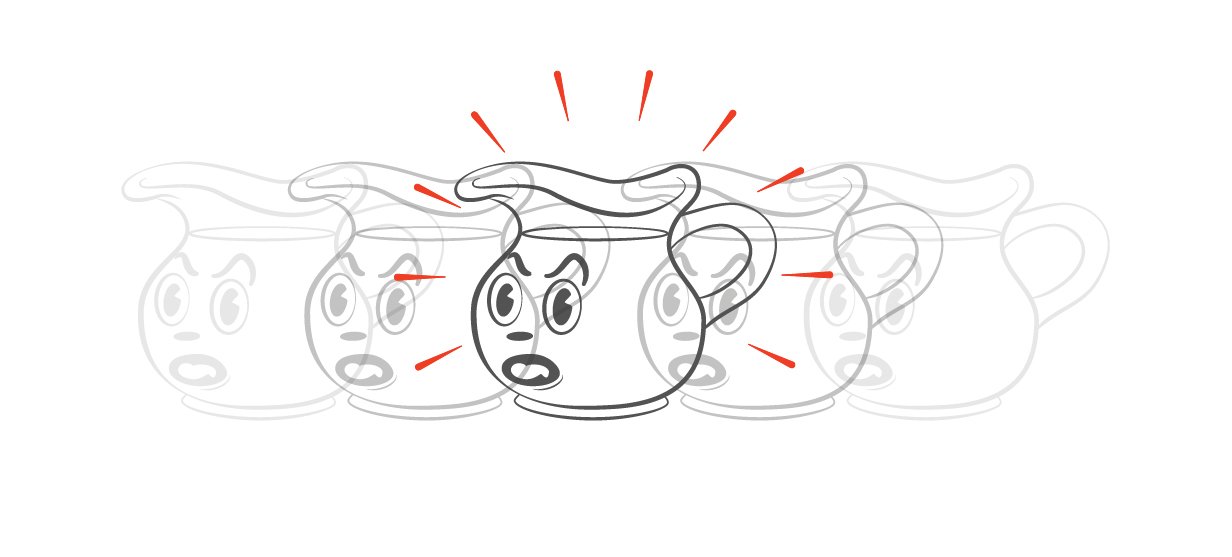
Compare his extended example of the jug with the pictures from Betty Boop for President, a Max Fleischer cartoon from 1931. Here, the jug is not an object made of clay. By Heidegger’s terms, it is the gift of holding and pouring of water for the dry mouths of political speakers expressing themselves. That makes it a Thing.
The cartoon thing pushes the limits of the Heideggerian Thing by giving it an autonomy beyond functional capacity and beyond that which it gives it meaning in the world. It gives it consciousness, and based on this jug’s actions, thirst.
The body as instrument and the instrument as extension of the body is another dialectical relationship which governs the cartoon world. Here, figures metamorphosize into their utility at the exact time they’re needed. Benjamin recognizes this in his example of the cartoon body of Mickey Mouse, who appears intermittently in his work. He doesn’t just recognize the cartoon body, he politicizes it by contextualizing it as a productive fantasy based on the needs and wants of the working poor. In Experience and Poverty, he writes:
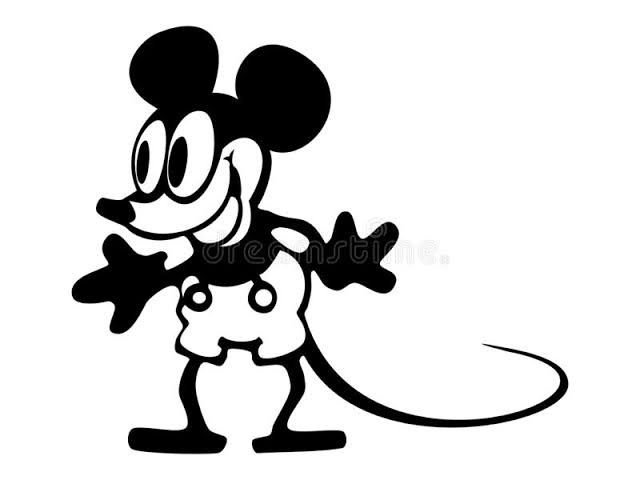
[The cartoon world] is full of miracles that not only surpass those of technology but make fun of them.. for the most curious thing about them is that they all emanate, without machinery and improvised, from the body of Mickey Mouse, his partisans and pursuers, from the most quotidian furniture just as from trees, clouds or a lake. Nature and technology, primitivism and comfort have completely become one, and before the eyes of people who have grown tired of the endless complications of the everyday and to whom the purpose of life appears as nothing more than a distant vanishing point in an endless perspective of means, there appears as a redemption an existence which at every turn is self sufficient in the most simple and simultaneously most comfortable way, in which a car does not weigh more than a straw hat and the fruit on the tree grows round as fast as a hot air balloon.14
14Walter Benjamin, “Mickey Mouse,” in Walter Benjamin: Selected Writings, Volume 2, Part 2, 1931–1934, ed. Michael W. Jennings, Howard Eiland, and Gary Smith, trans. Rodney Livingstone (Cambridge, MA: Harvard University Press, 1999), 545–46.
Industrialized Perception as Innervation
This brings us to utility and Benjamin’s innervation. Innervation is a term borrowed from Freud, who used it in a neurological context to mean the process by which the impulse travels from the psychic domain to the somatic through the nervous system. In Benjamin’s terms, innervation is the concept by which the typical cartoon of the Depression era becomes something almost transcendent. Its ontology is a product of a technology that uses the (human) eye’s nature to see a series of still pictures above 1/16th of a second as a moving image. It is an illusion that is afforded by the natural inadequacies of the eye. How the eye developed this limitation is unknown. The cartoon world is populated with images of bodies/objects that transform at any given moment. Cartoon bodies magically adapt.
The concept of industrialized perception discussed earlier in this essay (Part 1) is the process by which an audience’s very perception is transformed by the experience of immersive technology (in this case, film). The “industrial” here is what tailors the concept to that which is commercial.
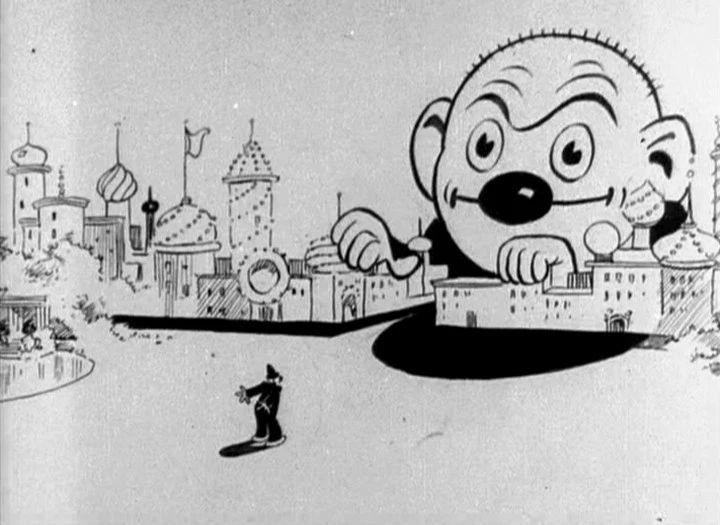
Benjamin’s use of innervation is one which places the cinema as an instrument of adaptation to human vision and perception. Miriam Hansen describes the full political evolution of this adaptation.
The notion of a “collective innervation” of technology [is] linked to the idea of an integral “body and image space”…The central arenas for such innervation, as Benjamin increasingly came to realize, were the technical media photography, film, radio, the gramophone that is, the very technologies that participate in the historical proliferation of the shock experience and thus escalate the spiral of sensory alienation, phantasmagoria, and violence. The expropriation of the human senses that culminates in Imperialist warfare and fascism can be countered only on the terrain of technology itself , by means of perceptual technologies that allow for a figurative, mimetic engagement with technologies at large, as a productive force and social reality.15
15Hansen, Miriam Bratu. “Benjamin and Cinema: Not a One-Way Street.” New German Critique 97 (2006): 293–313.
Benjamin postulates the psycho-physiological element becomes an animated film’s therapeutic strategy. It’s a strategy of sublimating the neurosis of the modern industrial spectator/subject, part of the alleged “psychosis” believed by some to be a by‑product of the over‑stimulated modern sensorium
Cartoon Violence and Desire
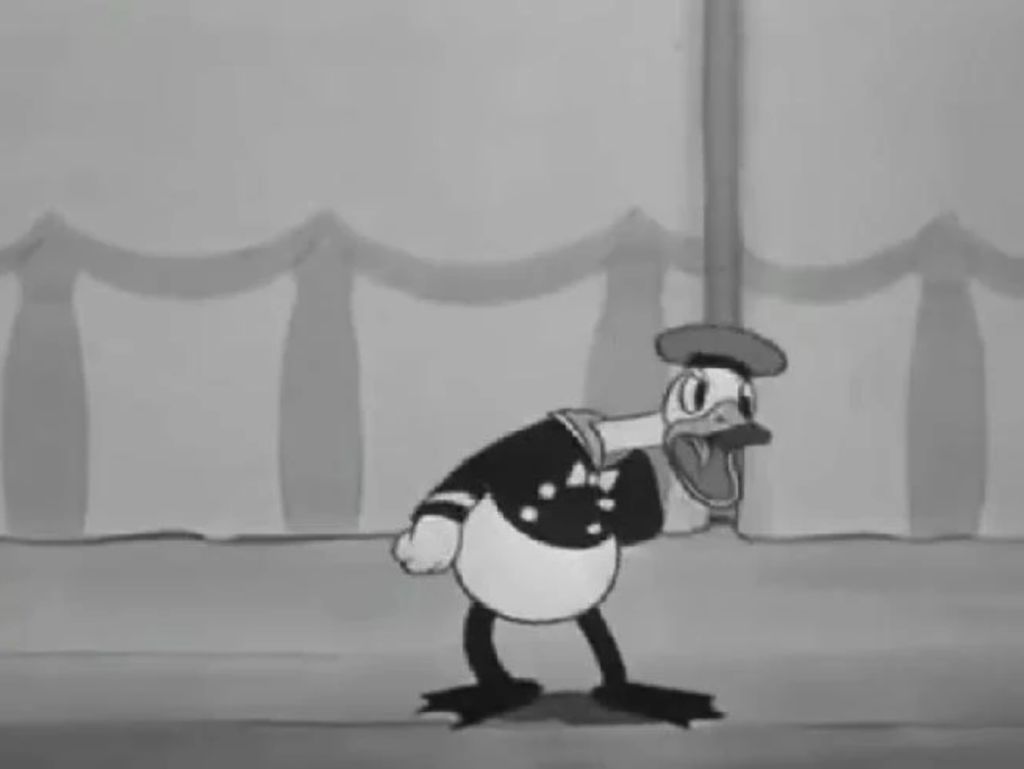
Cartoon violence is another topic in which Adorno and Benjamin use the same means to get to different ends. In his usual pessimism, Adorno writes:
To the extent that cartoons do more than accustom the senses to the new tempo, they hammer into every brain the old lesson that continuous attrition, the breaking of all individual resistance, is the condition of life in this society. Donald Duck in the cartoons and the unfortunate victim in real life receive their beatings so that the spectators can accustom themselves to theirs.16
16Theodor W. Adorno and Max Horkheimer, Dialectic of Enlightenment: Philosophical Fragments, trans. Edmund Jephcott (Stanford, CA: Stanford University Press, 2002) 110.
The alleged use of sadism and masochism in the spectator/cartoon body relationship is, a forced Freudian theoretical appendage to an analysis of the cartoon’s psycho-genetic rhythm and radical morphogenetics of its imagery. Its fast paced hallucinatory experience and humor, according to Benjamin, function cathartically.
While violence is certainly a part of the cartoon world, it is not a violence that satisfies the sadist’s desire to cause pain and suffering. Cartoon violence is not only a slapstick violence, but generally, a fleshless one.
How do the impulse dynamics in the optical unconscious enable the cartoon body’s therapeutic function? Benjamin writes:
If one takes into account the dangerous tensions which technification and its consequences have engendered in the vast masses tensions which, at critical stages, take on a psychotic character one cannot but recognize that this same technification has created as a protection against such mass psychosis the possibility of psychic inoculation by means of certain films in which a forced articulation of sadistic fantasies or masochistic delusions can prevent their natural and dangerous ripening in the masses. The collective laughter signifies a premature and therapeutic eruption of such mass psychoses17
17Benjamin, The Work of Art et. al. from Gesammelte Schriften, vol. 7. Translated by Miriam Hansen in Mice and Ducks, pp. 31‑2
Violent impact upon the cartoon body is registered as a hyperbolic change in form, sometimes without pain. Suffering is also cut short, in that injury tends not to be cumulative on the cartoon body. It heals itself instantly and does not consume the body. It is difficult to situate the cartoon body as a site of masochistic pleasure for the spectator when, in spite of its mimetic qualities, the cartoon body does not appear to be made of the same matter as the human body. The isomorphism of the mark—pen and ink governs the cartoon world. Even Betty Boop’s audaciously sexual figure is nothing more than an assemblage of flat, erotically-denotative shapes.
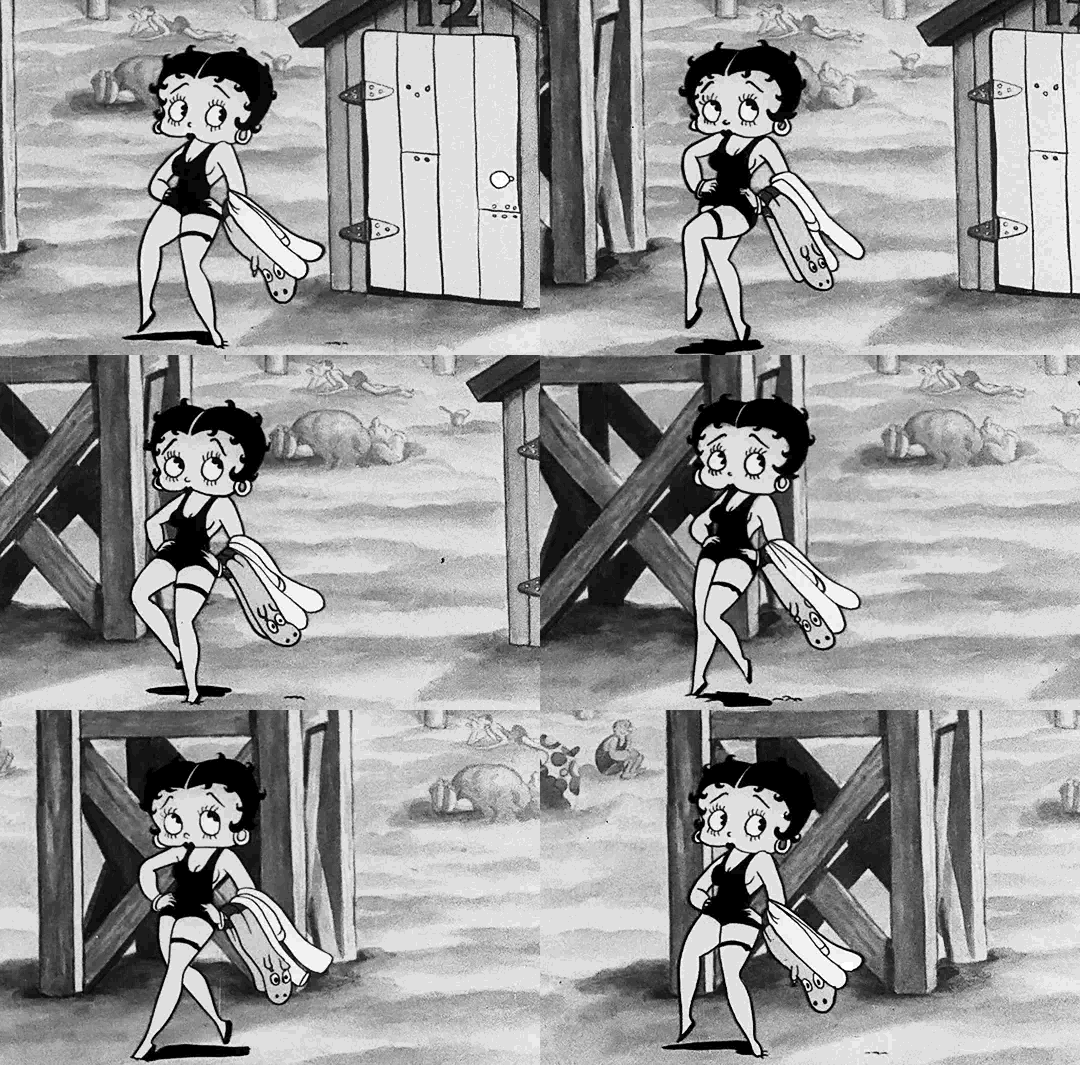
The cartoon’s manifestation of optical unconscious occurs through its laws of fragmentation, deformation and dissolution. It does so in service of humor with or without erotic or destructive impulses. Because the cartoon world is still tenuously connected to mimesis of the “real world,” its primary visual language is one of deformation rather than formation. The cartoon world absorbs the neurotic energy of the modern urban spectator through its use of parodic rapid deformation, rapid familiarization and de‑familiarization, and a parody of alienation.
In this way, the optical unconscious of the cartoon world, like the unconscious of classic psychoanalysis, fragments psychic, linguistic forms as a way of processing them within the cartoon’s own alternative “logic.” The difficulty of locating in the cartoon body, a site for the spectator’s sadistic/masochistic impulses is that the defamiliarized, fleshless, noncumulative violence of the cartoon world is governed only by the laws of the imaginary metamorphosis.
Ephemerality, delight, de‑formation: in this animated cartoon world, with all its violences, its mutations, subjections and humiliations, there is, unlike the real world, one corporeality that remains taboo: blood.