

Introduction
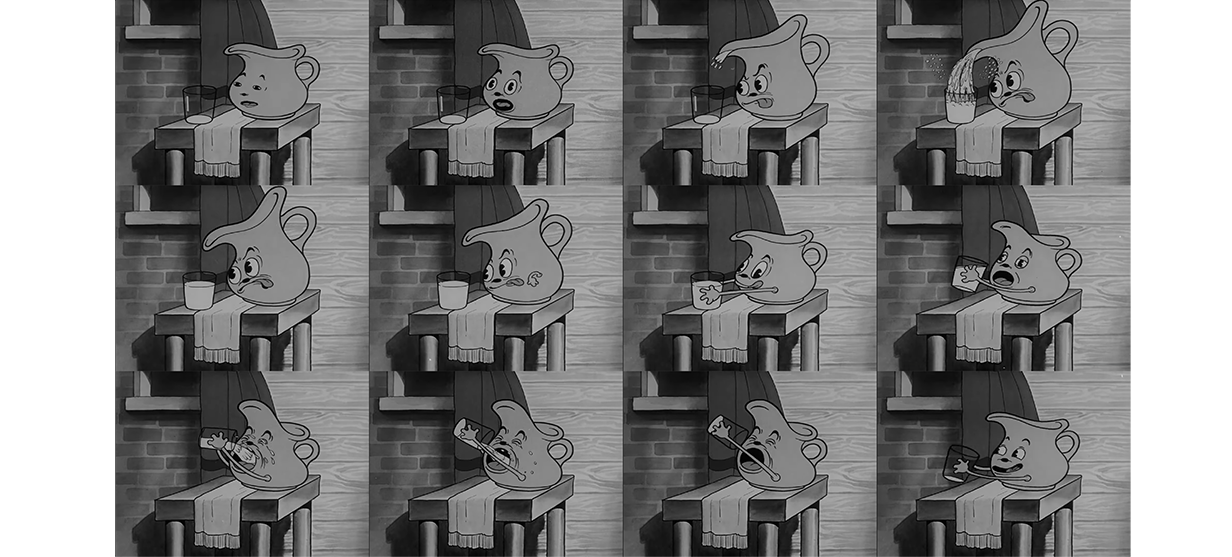
Even at the peak of the Great Depression, when 15 million Americans found themselves unemployed, some near destitute, strangers could still sit together in the dark and laugh. The grand movie-houses of the era had a little something for everyone: a newsreel, a serial short, a feature and of course, a cartoon.
The cinematic spectacle of these sound animated cartoons of the 1920s and 1930s marks an intensive threshold of media‑saturation for an audience whose very perception was being repatterned by the visual effects of scale, speed, repetition, and fragmentation of space and time.
A rich ecosystem of image-narratives which was formative in the development of a collective imagination of the era, reflecting commodity fetishism, scopophilia, escapism, cathartic violence, even masochism within the tidal-wave-sized paradigm shift known loosely as modernity.
The rubrics discussed here are based on a detailed analysis of a “cartoon universe” within a larger realm of cinema as collective entertainment in the culture industry.
The historical-theoretical question is: how do cartoons of a certain era interpret modern production, labor, individuation, and desire in a world transformed by both an increasingly complex market economy and a new consciousness of psychoanalysis as well as its absorption into popular culture?
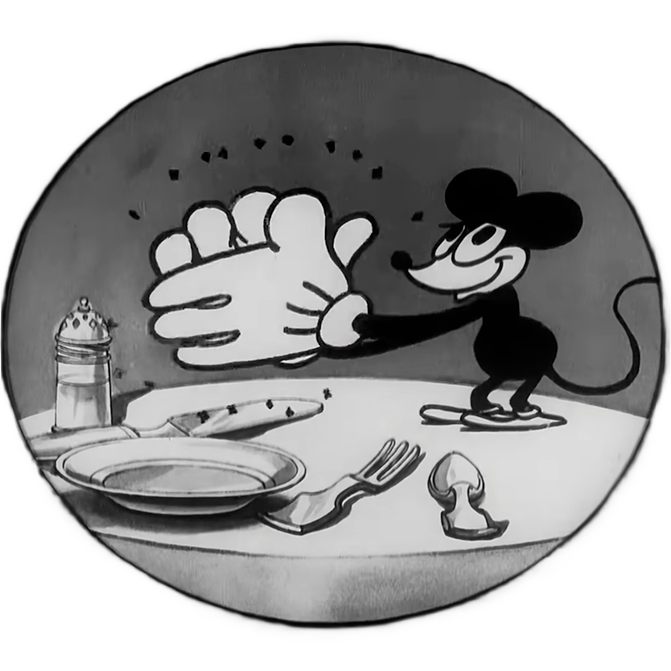
These cartoons reflect the increasing complexity of modern life and feed an ideology of an “industrialized utopia” which elevates capitalist production to a mythical state. They do so through visual tropes of utility-as-corporeality—objects become what they need to be at any given moment, a theme that resonated with depression-era audiences at a historical moment of great socioeconomic upheaval, political instability, and technology changing the way individuals work and play.
The critically influential dialogue of Frankfurt School critics Walter Benjamin and Theodor Adorno about the social function of the cinema, explores how cartoons, as publicly-viewed spectacles, examine the nature of collectivity in mass entertainment. The cartoon plays an instrumental role in this dialogue. Benjamin’s enthusiasm for the cartoon short has its place within a larger study of cinema as a technology, art, and social space, meaning, how it functions as a recreational event for an audience comprised of people from various socioeconomic backgrounds. Some of the same qualities are used in counterpoint by Theodor Adorno, who focuses on the mass culture industry as an extension of capitalism’s potential to alienate workers and exploit their labor.
Adorno, writing in 1939 on what would become one of his most well-known work The Dialectic of Enlightenment, has nothing but contempt for the entire culture industry. He condemns the cartoon in cinema as an institution which wastes the time and money of working people, offering them a distraction that, in his opinion, is nothing more than a bad habit:
All [cartoons] do today is to confirm the victory of technological reason over truth … Nothing that the experts have devised as a stimulant must escape the weary eye … this raises the question whether the culture industry fulfills the function of diverting minds which it boasts about so loudly … To walk from the street into the movie theater is no longer to enter a world of dream; despite its size, [the movie theater,] this bloated pleasure apparatus adds no dignity to man’s lives.1
1Theodor W. Adorno and Max Horkheimer, “The Culture Industry: Enlightenment as Mass Deception,” in Dialectic of Enlightenment, trans. Edmund Jephcott (Stanford, CA: Stanford University Press, 2002).
Benjamin describes, in cinema spectatorship, an intervention in the alienation process. He theorizes an intervention based on a collective point of identification as a precursor to solidarity.
The decisive reason [film has unique political power] is that nowhere more than in the cinema are the reactions of individuals, which add up to the massive reaction of the audience, from the onset determined by their imminent concentration and aggregation. By becoming public they control one another.2
2Walter Benjamin, “The Work of Art in the Age of Its Technological Reproducibility,” in Walter Benjamin: Selected Writings, Volume 3, 1935–1938, ed. Howard Eiland and Michael W. Jennings, trans. Edmund Jephcott et al. (Cambridge, MA: Harvard University Press, 2002),217-251.
Cinema, as the immersive technology of its time, restructured audiences on a physio-psychical level by translating consciousness through speed, repetition, fragmentation, and shock. On a social and cognitive level, points of identification and narrative influenced an audience’s view of itself and the world. These are the ingredients of an industrialized perception, and cartoons play an important role in its development in the face of socioeconomic, geopolitical and psychological upheavals characteristic of modern life.
The First Incarnation of the Aura
Benjamin, playing optimist to Adorno’s pessimism, finds, in cinema spectatorship, an intervention in the alienation process. And it does so through a collective point of identification as a precursor to solidarity.
Walter Benjamin’s profoundly influential 1936 essay The Work of Art in the Age of Mechanical Reproduction*(hereafter referred to as the “Work of Art essay”) forms the backbone of many theoretical explorations into the very dynamics of mass media and their cultural ramifications. A concept that is integral to Benjamin’s theory of media and cultural change is the aura. This is a complex and often problematic term for the study of Benjamin’s work because different incarnations of the term appear in his essays on Baudelaire and on photography. Benjamin introduces the aura in the Work of Art essay as follows:
The authenticity of a thing is the essence of all that is transmissible from its beginning, ranging from its substantive duration to its testimony to the history which it has experienced. Since the historical testimony rests on the authenticity, the former, too, is jeopardized by reproduction when substantive duration ceases to matter. And what is really jeopardized when the historical testimony is affected is the authority of the object.
“One might subsume the eliminated element in the term ‘aura’ and go on to say: that which withers in the age of mechanical reproduction is the aura of the work of art … By making many reproductions it substitutes a plurality of copies for a unique existence.”3
3Walter Benjamin, “A Little History of Photography,” in Walter Benjamin: Selected Writings, Volume 2, 1927–1934, ed. Michael W. Jennings, Howard Eiland, and Gary Smith, trans. Edmund Jephcott et al. (Cambridge, MA: Harvard University Press, 1999), 507-540.
*This essay is sometimes referred to as “The Work of Art in the Age of its Technological Reproducibility” its original title, to indicate an earlier version of the text.
In other words, a precious object (let’s call it a traditional ‘artwork’) derives its value from its mortality as a physical object and the history of its existence. Both types of value come down to its authenticity. When something is mass-produced, the concept of authenticity is removed, both types of value are no longer relevant, thereby also removing the authority of the object. This authority is its aura.
However, if we wait for the other shoe to drop, Benjamin will explain that the loss of the aura is not necessarily something to be mourned. This is only the beginning of the aura and its exploration. It’s a concept which will return in much of Benjamin’s writing and in our discussion of it.
What’s a Morphological Economy?
The cartoon universe has an inherent economy that, at first glance, has little to do with capitalism. It is an economy of visual form.
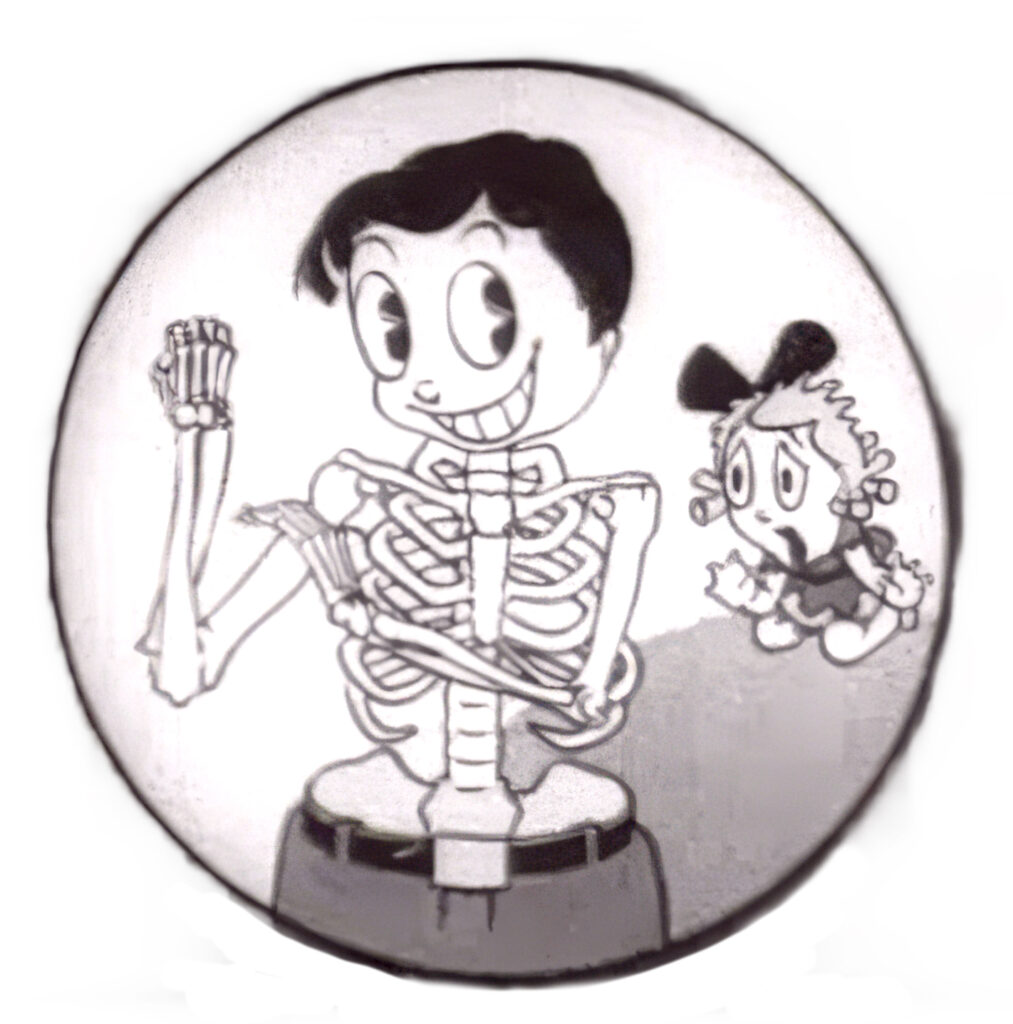
Cartoon bodies pass between animate and inanimate, between organism and machine, between singular and plural. The visual isomorphism of the cartoon acts as a currency mediating subject/object relationships. This is a morphological economy.
The (traditional) animated cartoon image contains not just drawings, but drawings of a specific visual style. As flat, ink drawings, all elements of volume, texture and space are translated into the graphic marks. These marks, in turn, divide the paper plane into various forms whose presence in space and material qualities are denoted through these marks as signs. Because space and materiality are determined by signification and not by any natural law, they can be suspended, inverted or otherwise manipulated in any number of ways.
The dynamics of the morphological economy create a fluctuation of subject/object status and the animate with the (normally) inanimate. The mingling of fluid cartoon bodies objects, vacillating between poles of materiality and immateriality are transformed by their own utility. This economy works as a trope for what Benjamin calls innervation, a term borrowed from psychoanalysis but employed as a concept of mediation between technology and the body. This will be explored more thoroughly later in this essay (Part 2).
The Enchantment Factory
Warner Bros.’ Merrie Melodies cartoons, among others from the 1930s are not as straightforwardly political as the later propaganda cartoons dealing explicitly with the Second World War, such as 1943’s Daffy Commando and Tokyo Jokyo, but they are undeniably ideological. And, in fact, we can see in cartoons of the early sound era, the earmarks of a political creative template in which factories become the vehicle for an industrialized capitalist fantasy.
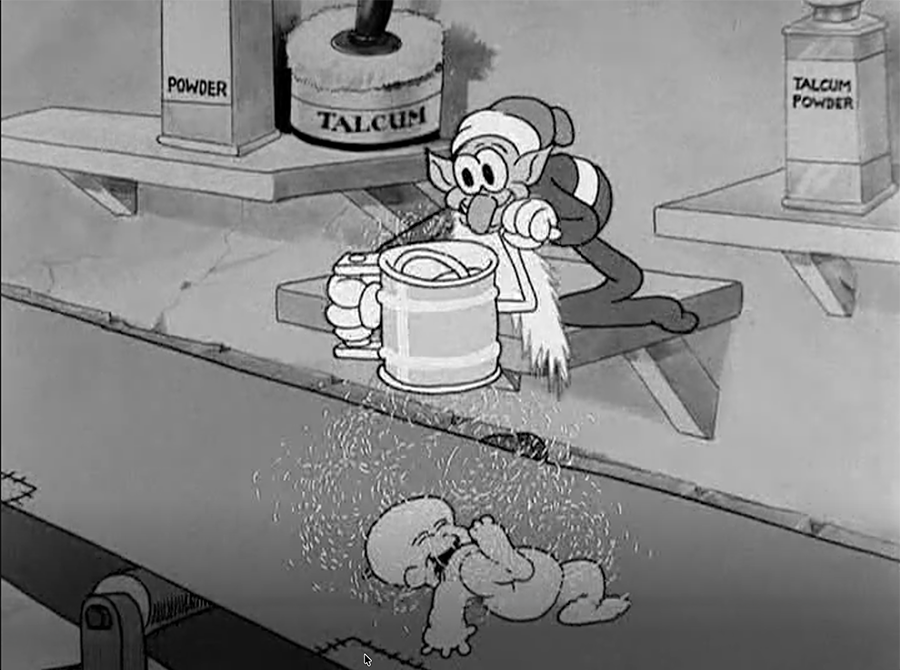
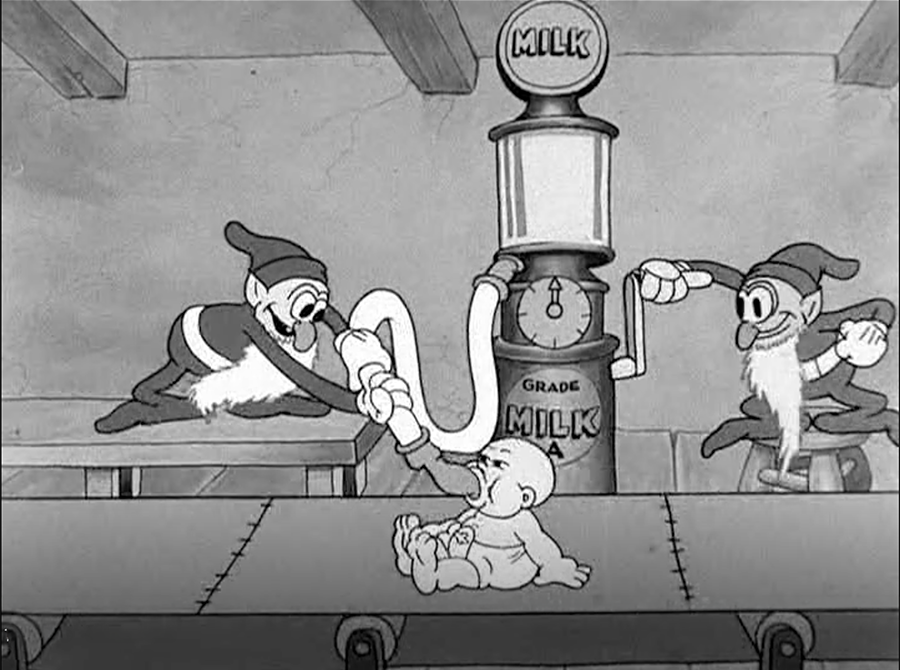
In the “enchanted labor” cartoon, a natural phenomenon is given an origin in some kind of fantasy “factory”, complete with assembly line and Taylorized divisions of mechanized labor, performed, of course, by an always cheerful and acquiescent team of elves or some other magical hobgoblin. A hallmark of these is a Merrie Melody cartoon of 1933 called Shuffle Off to Buffalo, used in context of the Warner Bros. musical 42nd Street released the same year.
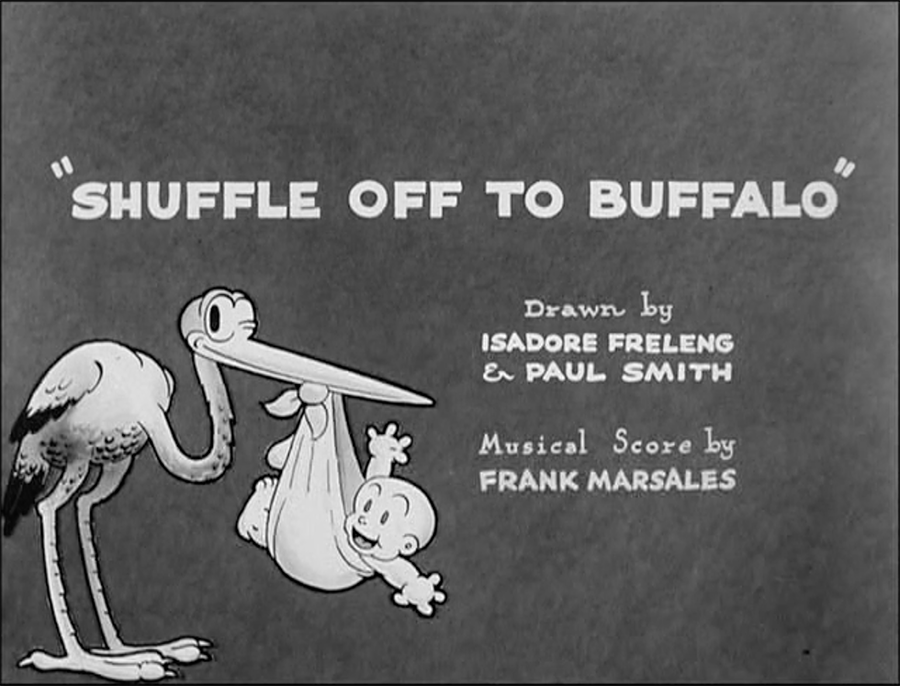
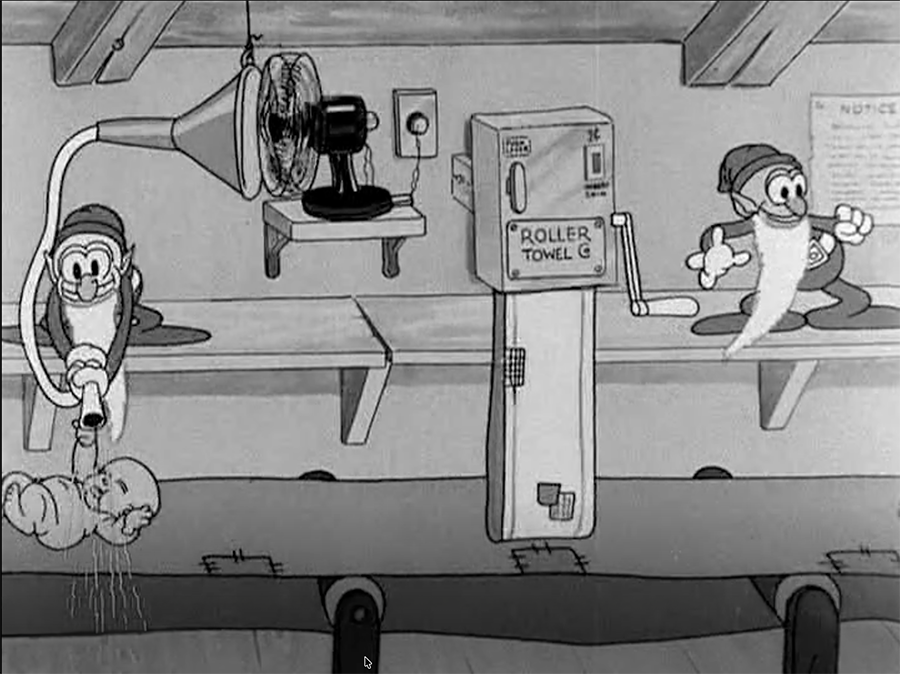
Set in a magic factory among the hilltops, flocks of storks come to bring babies of every size, shape and stereotyped color to be “processed” (bathed, dried, powdered, milk-fed and diapered) before delivery. The cartoon is racist, which is, unfortunately, not surprising for the era. As an afterthought, Shuffle Off to Buffalo is also a pun on childbirth and labor.
To Spring, another enchanted labor cartoon by Harman & Ising, centers around the production of the changing seasons. Hundreds of happy‑go‑lucky elves furiously prepare, by accomplishing (again, Taylorist assembly‑line style) various tasks rife with sentiment: painting flowers, rainbows, etc., to bring springtime in on time. The message of the enchanted labor cartoons is simple and undeniable: America works.
The attempt to erase the line between work and play is certainly a central strategy of these cartoons. What is more provocative within a Marxist perspective, is their inversion of the relationship between nature and industry. By enchanting the scene of industrial production and mechanization to such an extent, these cartoons testify to the mystification of capital and a market economy in which all things, the weather, flowers, human beings—everything is a commodity, as a result of the magical miraculation-machine of capitalism.
Benjamin places the cinema as the strongest medium of modernity. For him, the capacity for mass media, whether printed, photographic or cinematic creates an art that is no longer shackled to tradition and exhibition value, an art which, in its very collectivity, criticizes the culture of the salon as the bourgeois site for the transmission of high culture. This is a revolutionary potential of cinema, something filmmakers like Sergei Eisenstein embraced a decade earlier. It is infused with political agency that destabilizes an existing social order.
Unlike critics such as Georg Simmel, who equated mass production of all kinds as an attack on the integrity of craftsmanship and tradition, Benjamin saw in mechanical reproduction the implications of distribution and accessibility to cultural experiences previously reserved only for the members of a particular socioeconomic class (this is the other shoe dropping):
“In permitting the reproduction to meet the beholder or listener in his own particular situation, it reactivates the object reproduced… With the advent of the first truly revolutionary means of reproduction, photography, simultaneously with the rise of socialism, art sensed the approaching crisis which has become evident a century later … But the instant the criterion of authenticity ceases to be applicable to artistic production, the total function of art is reversed. Instead of being based on ritual, it begins to be based on another practice— politics.” 4
4Walter Benjamin, “The Work of Art in the Age of Mechanical Reproduction” (also translated as “The Work of Art in the Age of Its Technological Reproducibility”), in Illuminations: Essays and Reflections, ed. Hannah Arendt, trans. Harry Zohn (New York: Schocken Books, 1968), 221.
The Aura Returns
At this point, it is still possible to think of the animated cartoon in terms of possession or loss of aura: the film is mass produced, and therefore, has no aura, even if the individual cels, as paintings, still retain the status of auratic objects.
Looking at someone carries the implicit expectation that our look will be returned by the object of our gaze. Where this expectation is met,…there is an experience of the aura to the fullest extent … Experience of the aura thus rests on the transposition of a response common in human relationships to the relationship between the inanimate or natural object and man … To perceive the aura of an object we look at means to invest it with the ability to look at us in return. ” 5
5Walter Benjamin, “On Some Motifs in Baudelaire” (1939), in Walter Benjamin: Selected Writings, Volume 4, 1938–1940, ed. Howard Eiland and Michael W. Jennings, trans. Edmund Jephcott et al. Cambridge, MA: Harvard University Press, 200.
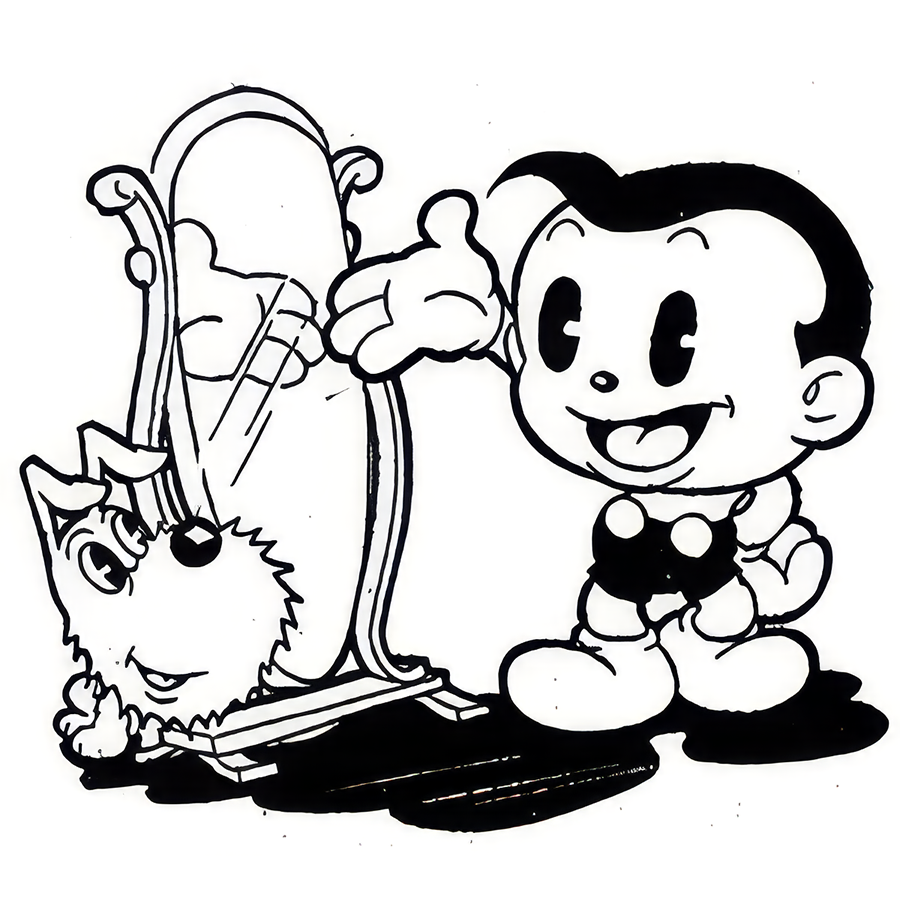
Benjamin makes it clear that the gaze of the art object should not be misinterpreted as the gaze of a figurative image. This is not a gaze that comes from eyes. The gaze that is returned by an object is elicited from the viewer experiencing its aura. It is relational.
At a particular point in the Work of Art essay, Benjamin describes how film breaks the reciprocity of the gaze. The actor performs for an optic apparatus that is the camera—an empty, surrogate audience which does not return the performers gaze. The film spectators see an ephemeral mass-produced image which, in turn, does not return their gaze:
For the film, what matters primarily is that the actor represents himself to the public before a camera, rather than representing someone else … What matters is that the part is not acted for an audience but for a mechanical contrivance‑‑in the case of the sound film, two of them… [The actor] has to operate with his whole living person, yet forgoing its aura. For aura is tied to his presence; there can be no replica of it.6
6Walter Benjamin, “The Work of Art in the Age of Mechanical Reproduction,” in Walter Benjamin: Selected Writings, Volume 3, 1935–1938, ed. Howard Eiland and Michael W. Jennings, trans. Edmund Jephcott et al. (Cambridge, MA: Harvard University Press, 2002), 236-234.
It is precisely here that the animated cartoon unhinges the terms by which film’s loss of aura are being discussed. Why? Because it is a discussion that relies entirely on the camera’s capacity to record a live event. While the individual frames of the animated cartoon are indeed “recordings” of the cel drawings; they are not the ephemeral duration of film itself. The individual cel drawings that make up the frames of the cartoon are raw material. They are no more the cartoon’s entirety than the scripted words on the page are the entirety of the actor’s performance.
The cartoon world is conjured. As an ephemera, it is ontologically dependent on the mechanisms of the camera and projector. The animated cartoon is not an original performance or a recording, but exists in a third space which ruptures the dialectic. It is what Jean Baudrillard would call, 50 odd years later, a simulacrum: a copy without an original. And it signals an implosion of the lack of aura and the dynamics of the gaze.
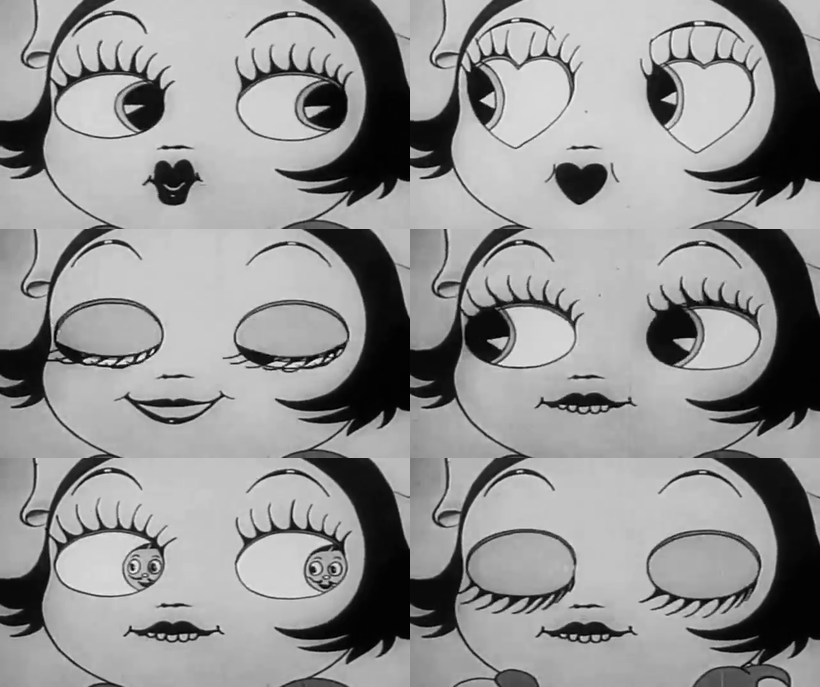
In the Work of Art essay, Walter Benjamin sets up his master metaphor between painting and film: the painter-as-magician and the filmmaker-as-surgeon:
The magician heals a sick person by the laying on of hands; the surgeon cuts into the patient’s body. The magician maintains the natural distance between the patient and himself. The surgeon does exactly the reverse; he greatly diminishes the distance between himself and the patient by penetrating into the patient’s body, and increases it but little by the caution with which his hand moves among the organs… Magician and surgeon compare to painter and cameraman. The painter maintains in his work a natural distance from reality, the cameraman penetrates deeply into its web.7
7Walter Benjamin, “The Work of Art in the Age of Mechanical Reproduction,” in Illuminations: Essays and Reflections, ed. Hannah Arendt, trans. Harry Zohn (New York: Schocken Books, 1968), 232–234
What, then, is maker of cartoons, those strange hybrids that use both painting and filmmaking but are neither of those? Some strange charlatan or witch‑doctor, who seizes the natural perception of the eye? What kind of voodoo is it that creates still figures whose movement at 1/16 of a second exists nowhere else but as an ephemera created by a congealed artifact ticking through its designated machine?
The Optical Unconscious
In A Little History of Photography, Benjamin writes about how film’s dynamics of time, space, and proximity are concentrated in the camera eye. With those dynamics are micro-events, impossible points-of-view, refracted movements—all details which can only exist on a layer of perception in what Benjamin calls the optical unconscious, he writes:
It is another nature which speaks to the camera rather than to the eye; other above all in the sense that a space informed by human consciousness gives way to a space informed by the unconscious. Whereas it is a commonplace that, for example, we have some idea of what is involved in the act of walking… We have no idea at all what happens during the fraction of a second when a person actually takes a step. Photography, with its devices of slow-motion and enlargement, reveals the secret. It is through photography that we first discover the existence of this optical unconscious, just as we discover the instinctual unconscious through psychoanalysis.8
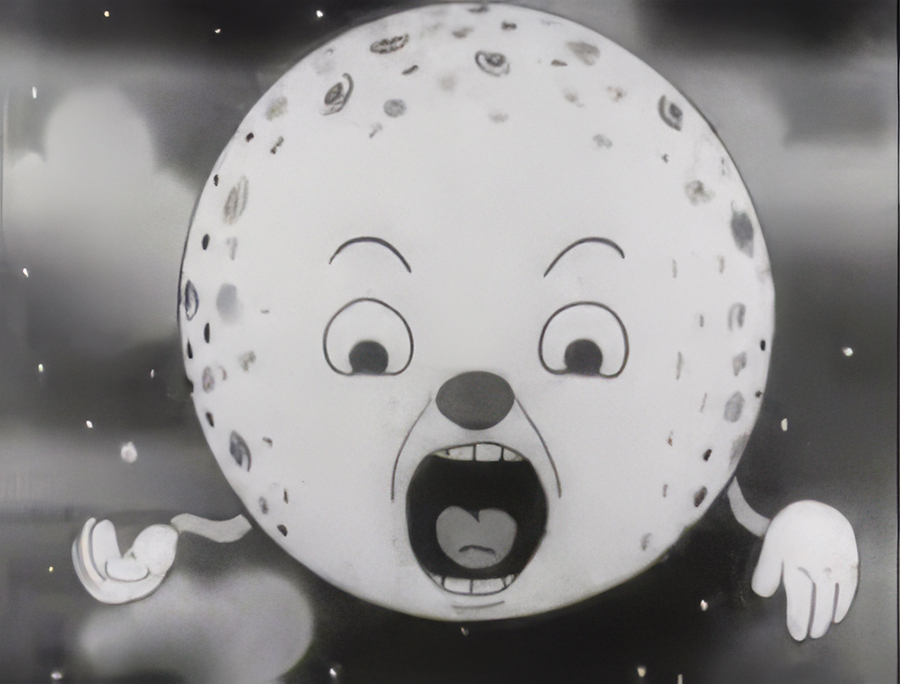
Benjamin’s optical unconscious is, on one level, patterns of the visual world which we can see only through the camera eye, that which is beyond the ability of the naked eye. The camera enlarges, shrinks, speeds up, slows down; it splits time, space and movement.
The vocabulary of cinema is comprised, in part, of image experiences which are beyond our reach in real life. But the optical unconscious also has the ability to reveal hidden realities, not just the science of vision and photography, but the psychological, social, and political. It is capable of being populated by images of ideology and desire.
In the Work of Art essay, Benjamin arrives at the optical unconscious through his analysis of what the camera-eye makes visible beyond its technology:
The characteristics of the film lie not only in the manner in which man presents himself to mechanical equipment but also in the manner in which, by means of this apparatus, man can represent his environment. A glance at occupational psychology illustrates the testing capacity of the equipment. Psychoanalysis illustrates it in a different perspective. The film has enriched our field of perception with methods which can be illustrated by those of Freudian theory. Fifty years ago, a slip of the tongue passed more or less unnoticed. Only exceptionally may such a slip have revealed dimensions of depth in a conversation which had seemed to be taking its course on the surface9
9Walter Benjamin, “The Work of Art in the Age of Mechanical Reproduction” (also translated as “The Work of Art in the Age of Its Technological Reproducibility”), in Illuminations: Essays and Reflections, ed. Hannah Arendt, trans. Harry Zohn (New York: Schocken Books, 1968), 217–251
Benjamin scholar Miriam Hansen uses Benjamin’s own words to directly connect the optical unconscious with psychoanalytic space and modern life. In Benjamin, Cinema and Experience: The Blue Flower in the Land of Technology she writes:
Film… not only makes visible formations hitherto invisible to the human eye, but …registers aspects of psycho perceptual reality that only emerged, historically, with modern technology; as Benjamin put it elsewhere, film gives rise to “a new region of consciousness.” Benjamin locates them largely “outside the normal spectrum of sense perceptions,” in the region of “psychoses, hallucinations and dreams.” Thus, “the deformations and stereotypes, transformations and catastrophes that may occur in the perceptual world of film” provide an unconscious optics for the borderline experience that comes with the pressures of urban industrial modernity.10
10.Miriam Bratu Hansen, “Benjamin, Cinema and Experience: ‘The Blue Flower in the Land of Technology,’” New German Critique 40 (1987): 179–224.
The cartoon is an exemplary medium to illustrate the relationship of an optical unconscious because of the morphological economy. The auratic elements of the actor, corporeality of the body–when applied to an animated cartoon–are not a matter of loss, but a matter of lack. Their origin is not in a “real” referenced in a painted image, but by the trickery with which the film presents its quasi‑mimetic figure.
End of Part 1